

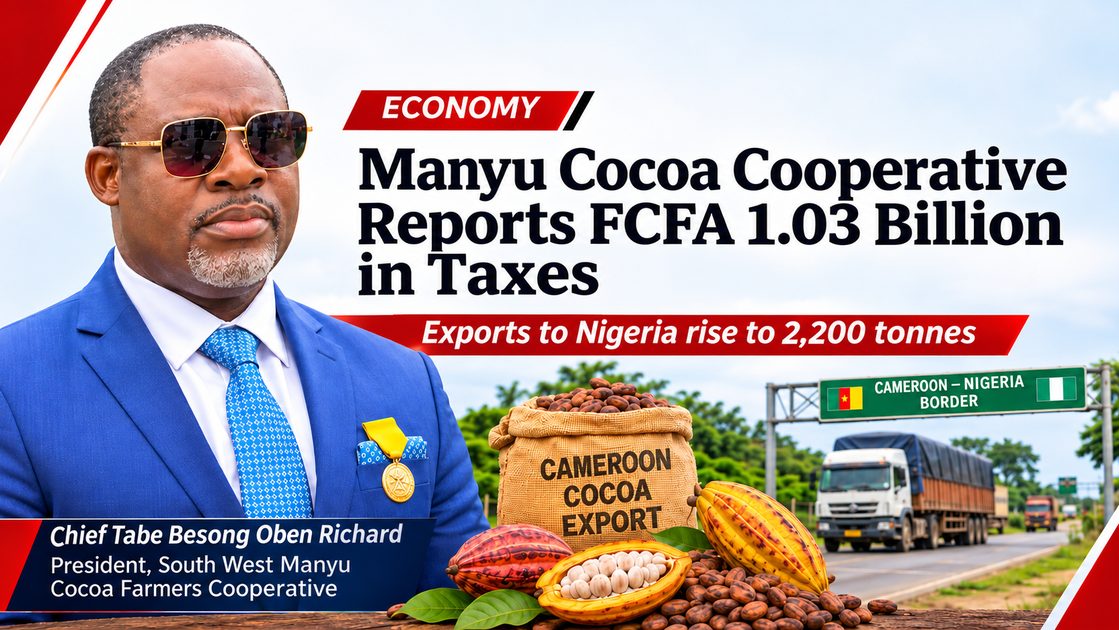
A cocoa farmers’ cooperative in Cameroon’s South West Region says it paid approximately FCFA 1.03 billion in customs duties and taxes in 2025 after exporting cocoa to neighbouring Nigeria. The cooperative also reports an increase in export volumes, raising questions about how formal cross-border trade can benefit government revenue and cocoa farmers.
The figures were presented by the South West Manyu Cocoa Farmers Exporters Cooperative during an extraordinary general assembly held in Limbe on 28 October 2026.
According to Cameroon Tribune’s report of 3 November 2026, the cooperative’s Board Chairman, Chief Tabe Besong Oben Richard, said the organisation exported about 2,200 tonnes of cocoa to Nigeria in 2025, compared with 1,850 tonnes in 2024.
He also disclosed that the cooperative’s payments to the state increased from more than FCFA 860 million in 2024 to approximately FCFA 1.03 billion in 2025.
The figures represent the cooperative’s reported activities. A publicly available breakdown of the payments, showing the different taxes, duties and other charges, has not yet been independently verified.
Cocoa exports to Nigeria increase by nearly 19%
The cooperative’s reported export volume increased by approximately 18.9% between 2024 and 2025.
That represents an additional 350 tonnes of cocoa exported to Nigeria within one year.
The figures are significant for Manyu Division, where cocoa farming remains an important economic activity and where the ongoing security crisis in the South West Region has affected transport, agricultural marketing and other commercial activities.
Chief Tabe Besong Oben Richard explained that the cooperative was established in 2023 to help cocoa farmers market their produce through recognised channels.
According to his account, many farmers previously faced difficulties accessing buyers and depended on informal cross-border arrangements to sell their cocoa.
The cooperative says its operations have made it possible for farmers to sell cocoa to buyers in Nigeria through registered export channels.
The chairman also stated that the Ministry of Finance issued the organisation a certificate of recognition for its contribution to government revenue.
However, the certificate and supporting tax-payment records were not included in the information reviewed for this report.
What the National Cocoa and Coffee Board records show
Figures attributed to Cameroon’s National Cocoa and Coffee Board (NCCB/ONCC) provide additional evidence that South West Manyu has been involved in registered cocoa exports.
According to Business in Cameroon, the Board’s report for the 2024–2025 cocoa marketing season recorded 1,925 tonnes of cocoa beans exported by the cooperative.
Those exports reportedly had a Free on Board (FOB) value of approximately FCFA 10.66 billion.
The report also identified South West Manyu as the only operator that registered overland cocoa export contracts to Nigeria during that marketing season.
These figures are important, but the reporting periods must be clearly distinguished.
The cooperative’s 2,200-tonne figure covers the 2025 calendar year, while the NCCB’s 1,925-tonne figure relates to the 2024–2025 cocoa marketing season.
Consequently, the two figures cannot be compared directly without examining their respective reporting dates and export declarations.
They nevertheless indicate that substantial quantities of cocoa have been exported through the cooperative’s registered operations.
Does formal cocoa trade mean better earnings for farmers?
The cooperative’s chairman believes the arrangement has improved the incomes of cocoa producers in Manyu.
His argument is that farmers can now access the Nigerian market more directly, reducing their dependence on traditional intermediaries.
This could be beneficial, especially in communities where access to buyers and reliable transport remains difficult.
However, the information released by the cooperative does not establish how much individual farmers actually earn from the arrangement.
For example, the reported export figures do not disclose the average price farmers received per kilogram, deductions for transportation, storage and handling, or the net amounts paid to cooperative members.
These details are necessary before concluding that farmers earn more through the cooperative than through alternative buyers.
It is also important to distinguish export value from farmgate income.
The FCFA 10.66 billion FOB value reported for the 2024–2025 season represents the value of cocoa at the specified export stage. It does not mean that the entire amount was paid to cocoa farmers.
The costs associated with purchasing, assembling, transporting and exporting cocoa must be considered when assessing what producers ultimately receive.
Informal cocoa exports to Nigeria remain a major challenge
The cooperative’s reported achievements come against the background of substantial informal cocoa trade between Cameroon and Nigeria.
According to the National Institute of Statistics (INS) report on informal cross-border trade in 2024, Cameroon’s informal cocoa bean exports to Nigeria were valued at approximately FCFA 41.4 billion in 2024.
The figure represented an increase of 145.6% compared with 2023.
The report also indicated that cocoa beans accounted for approximately 63.9% of Cameroon’s informal export receipts from Nigeria.
This demonstrates the importance of cocoa in trade between the two neighbouring countries.
However, the FCFA 41.4 billion figure represents the estimated value of cocoa traded informally. It is not the amount of taxes lost by the government.
It would therefore be inaccurate to compare that figure directly with the FCFA 1.03 billion that South West Manyu says it paid in duties and taxes.
Calculating government revenue lost through informal exports would require reliable information about the transactions, applicable tax rates, exemptions and other relevant charges.
Cameroon’s authorities have previously expressed concern about cocoa leaving the country through unregistered channels.
In September 2024, the Directorate General of Customs issued a reminder concerning the documentation required for cocoa exports through land and river borders, as explained in the Cameroon Trade Hub’s account of the customs requirements.
The documents identified include evidence of payment of applicable export duties and levies, customs assessment documents, phytosanitary certification and appropriate transport documentation.
Such requirements are intended to improve oversight and ensure that goods crossing the border are properly declared.
Government revenue and farmers’ income are different questions
The South West Manyu case raises two important economic questions.
The first concerns government revenue.
When cocoa exports are formally declared, they become part of the recorded trading system and may generate duties, taxes and other applicable payments.
This can improve the government’s ability to monitor trade flows and enforce regulations.
The second question concerns farmers’ welfare.
Formal registration alone does not guarantee that farmers receive better prices, faster payments or more favourable trading conditions.
For this reason, the cooperative’s reported contribution to government revenue should be assessed separately from its claims about improving farmers’ incomes.
Both can be positive developments, but each requires its own supporting evidence.
The cooperative could strengthen public confidence by disclosing more information on its transactions, producer payments and the structure of charges associated with its exports.
Such information would also help farmers understand how the value of their cocoa changes between the farm and the export market.
Why Nigeria remains important to Manyu cocoa farmers
Manyu Division has longstanding commercial and social links with neighbouring Nigeria.
For cocoa farmers in the area, access to Nigerian buyers can provide an additional market for their produce.
Where transport conditions, insecurity and other difficulties limit access to traditional cocoa-buying centres, alternative trading routes may become particularly important.
However, cross-border trade also requires compliance with the laws and regulations of the countries involved.
Exporters need reliable records of quantities, product quality, origin, contractual arrangements and applicable charges.
As international buyers increasingly demand traceability and proper documentation, cooperatives involved in cocoa exports may also have to strengthen their recordkeeping and quality-control systems.
These requirements can involve additional costs, but they can also help businesses establish more dependable commercial relationships.
The experience of South West Manyu therefore offers an opportunity to examine how formal cocoa marketing arrangements can operate in communities affected by insecurity and economic disruption.
For more reporting on Cameroon’s economic developments, see The Mentor’s Economy section and its Business coverage.
What still needs to be established
The cooperative’s announcement is encouraging for those seeking greater formal participation in Cameroon’s cocoa trade.
Its reported export growth, the amount it says it contributed to government revenue and the seasonal statistics attributed to the NCCB all point to significant commercial activity.
However, several important questions remain unanswered.
The reported FCFA 1.03 billion payment has not been supported in the available public reporting by a full breakdown of customs duties, taxes and other charges.
The cooperative has also not published sufficient comparative information to establish the extent to which farmers have benefited financially.
Further disclosures on export declarations, tax receipts, the number of participating farmers, average purchase prices and payments to producers would help provide a clearer picture.
What is established from the available reporting is that South West Manyu says it has increased formal cocoa exports to Nigeria and made substantial payments to the government.
Whether those achievements translate into sustained improvements in the livelihoods of cocoa farmers will depend on evidence of what producers actually receive.
For Manyu’s cocoa-growing communities, that may ultimately be the most important measure of success.
Sources and verification
- Cameroon Tribune — Cocoa Sales in 2025: Over 2,200 Tons Exported to Nigeria (3 November 2026). Original reporting of the cooperative’s extraordinary general assembly in Limbe.
- Business in Cameroon — Cameroon Cocoa Cooperative Reports CFA1.03 Billion in Taxes on Exports to Nigeria (5 November 2026). Follow-up reporting, including NCCB seasonal export statistics.
- National Institute of Statistics — Informal Cross-Border Trade in 2024. Official report containing the FCFA 41.4 billion estimate for informal cocoa trade with Nigeria.
- Cameroon Trade Hub — Combating Fraudulent Cocoa Bean Exports in Cameroon. Background on applicable cocoa export documentation.
- National Cocoa and Coffee Board. Official institution responsible for cocoa and coffee market information.
Verification note: The cooperative’s export volumes and tax payments are attributed to its leadership. NCCB seasonal figures have been cited through published reporting; the original operator-level table was not independently examined. The reported Ministry of Finance certificate and detailed tax receipts were not publicly verified for this article.
The Mentor News. All rights reserved.