

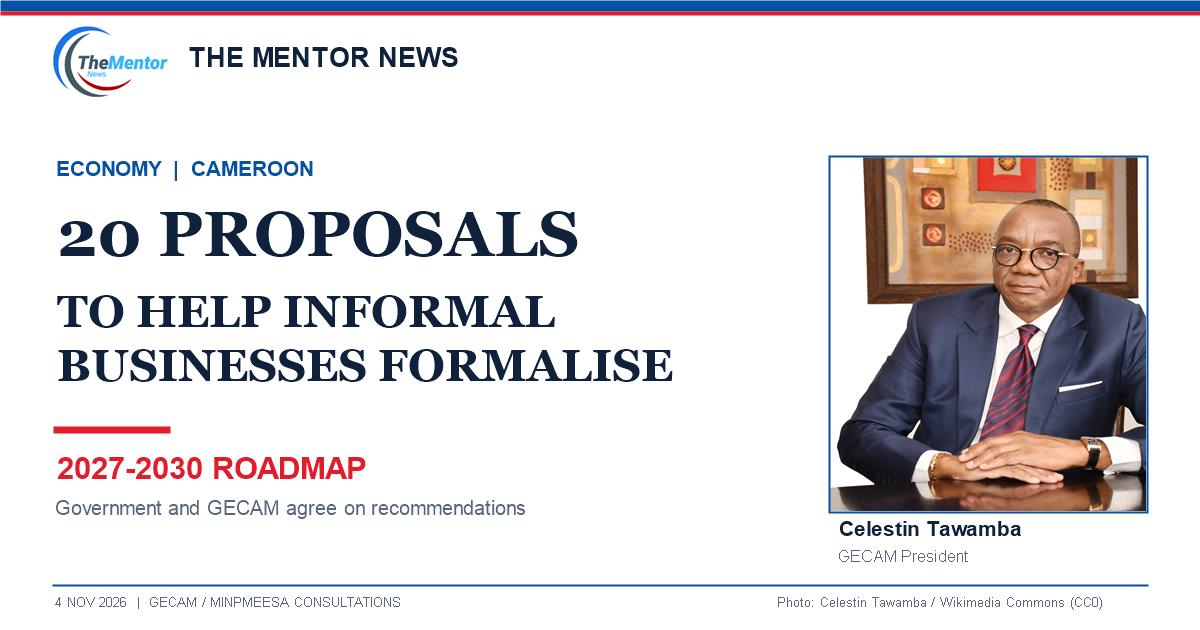
The Ministry of Small and Medium-Sized Enterprises and the Cameroon Employers’ Association (GECAM) have agreed on 20 proposals intended to make it easier for informal businesses to operate within the formal economy.
The measures followed a national consultation in Douala on 4 November 2026, attended by public authorities, business representatives, financial institutions and other participants.
SME Minister Achille Bassilekin III and GECAM President Célestin Tawamba signed a joint statement setting out the direction of the proposed reforms.
Taxes and access to finance
The discussions focused on taxation, the organisation of production chains and access to financing. Proposals reported from the meeting include reducing administrative obstacles, simplifying procedures and improving the ability of smaller operators to work with larger businesses.
Government statistics estimate that millions of informal production units operate in Cameroon. Many provide livelihoods but remain outside formal registration systems and may have limited access to credit, social protection and public procurement opportunities.
Formal registration can also create additional tax and administrative obligations. That makes the actual cost and simplicity of joining the formal sector central to whether the proposed approach will succeed.
What happens next?
The recommendations are expected to inform a roadmap covering 2027 to 2030, with responsibilities and implementation schedules to be defined.
For traders, artisans and small enterprises, the next test will be whether the proposals produce practical changes in registration, taxation and financing. At this stage, the 20 recommendations are commitments to a policy process, not measures already implemented.
What the consultation represents
The meeting brought together business representatives and public institutions to consider how more economic activity could move into registered and regulated structures. The outcome was a set of recommendations, rather than a package of laws immediately changing tax obligations for traders or small companies.
The distinction matters. A recommendation may influence a future policy paper or draft law, but a business does not acquire a new tax exemption merely because a consultation agreed that formalisation should be encouraged. Actual changes would require the relevant administrative, regulatory or legislative steps.
Why informal business remains widespread
Cameroon’s informal sector includes many different kinds of operators, from market vendors and small workshops to transport, agricultural processing and household enterprises. Some are individually run businesses with very limited turnover. Others have employees and established customers but may operate with only partial registration.
The ministry’s figures, cited during the debate, point to roughly 3.7 million informal production units in 2024. The statistic does not mean 3.7 million identical businesses, nor that every operator is deliberately avoiding tax. The reasons for informality can vary and need to be understood before policy is designed.
For a new small business, incorporation or registration may involve fees, records, bank requirements and ongoing obligations. Some operators see clear advantages in formal status, including easier contracting and better access to financial services. Others may see immediate costs without obvious commercial benefits.
Worth Read: Cameroon Business Forum 2026: Will Business Become Easier for Ordinary Cameroonians?
Taxation and predictability
Tax concerns were among the issues raised in the discussions. For a small shop, what matters is not only the nominal tax rate but also whether obligations are understandable and predictable. An entrepreneur needs to know which taxes apply, when to declare, which receipts to keep and what happens when cash flow is uneven.
Cameroon’s tax system already includes different regimes and obligations depending on the nature and size of business. It would be incorrect to suggest the proposed roadmap has abolished any existing registration, VAT or income-tax requirement. The emerging policy conversation concerns whether the overall system can make compliance more attractive and less difficult.
Finance and market access
Registered businesses can sometimes show financial statements, bank transactions and contractual records that help them apply for credit or compete for larger contracts. But formal status alone does not guarantee a bank loan. A lender still assesses repayment capacity, security, cash flows and other risks.
One important question is whether operators who formalise will gain practical access to markets, training, digital payments, procurement opportunities or appropriate financial services. These benefits could make a formal registration decision more worthwhile than a campaign focused only on enforcement.
The role of local councils
Municipal authorities interact with informal traders through market spaces, licences, local fees and enforcement. Any national roadmap will therefore be more effective if it considers how rules are administered at local level. Conflicting demands from different authorities can make compliance particularly confusing for small operators.
At the same time, local councils need revenue to provide services. Reform must address both fair collection and the commercial conditions under which small traders operate. The details matter more than broad declarations that everyone should register.
What should be made public
The signed statement is expected to guide a roadmap for 2027–2030. Businesses will need a clear description of the 20 proposals, responsible institutions, planned deadlines and how progress will be measured. Without those details, it will be difficult to tell which ideas move from consultation into practice.
There is an opportunity here for GECAM and the government to demonstrate that enterprise policy responds to the lived difficulties of Cameroonian businesses. Whether the initiative succeeds will depend on implemented measures, administrative experience and the choices made by businesses themselves.
Source and verification: Source information.
The Mentor News. All rights reserved.